Vietnam E-Learning Market Size, Share & Trends Analysis, 2032
Key Highlights
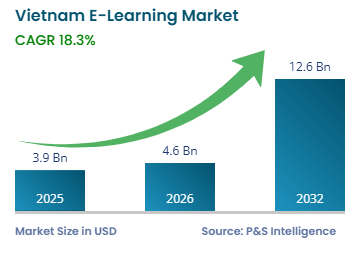
| Study Period | 2021 – 2032 |
| Market Size in 2025 | USD 3.9 Billion |
| Market Size in 2026 | USD 4.6 Billion |
| Market Size by 2032 | USD 12.6 Billion |
| Projected CAGR | 18.3% |
| Largest Province | Ho Chi Minh |
| Fastest-Growing Province | Hanoi |
| Market Structure | Fragmented |
Market Size
Explore the market potential with our data-driven report
Vietnam E-Learning Market Future Outlook
The Vietnamese e-learning market values USD 3.9 billion in 2025, and it is projected to reach USD 12.6 billion by 2032, growing at a CAGR of 18.3% during 2026–2032. This expansion is fueled by rising internet penetration, widespread smartphone adoption, and strong government support for digital transformation in education. Vietnam ranks among the top ten fastest-growing EdTech markets globally, driven by a young, tech-savvy population and cultural emphasis on educational achievement that encourages families to invest heavily in learning solutions.
Primary applications span K–12 supplementary education, higher education degree programs, corporate workforce training, and professional skills development, with language learning and STEM education representing particularly high-demand categories. Educational institutions and enterprises pursue e-learning implementation to address capacity constraints, reduce training costs, and deliver personalized learning experiences that improve knowledge retention.
According to the Ministry of Information and Communications, mobile broadband subscriptions reached 91.9 per 100 people in 2024, creating the connectivity infrastructure essential for widespread e-learning adoption. The Vietnamese government allocated approximately USD 200 million through its National Digital Transformation Program in Education to enhance e-learning infrastructure and integrate EdTech solutions into 80% of public schools by 2027, signaling sustained policy commitment to digital education expansion.
Vietnam E-Learning Market Segmentation Analysis
Provider Type Analysis
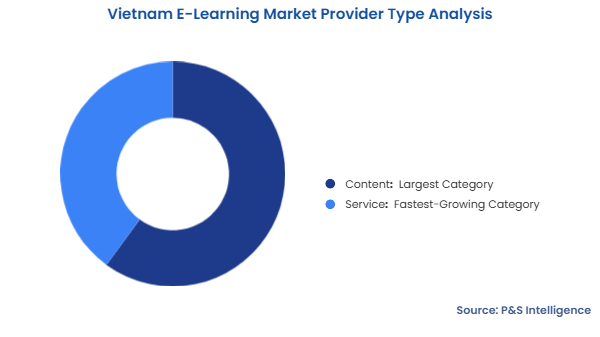
Content providers account for 60% of market value in 2025, driven by the strong demand for digital learning materials, online courses, and curriculum-aligned educational resources across academic and professional development segments. Vietnamese learners demonstrate the preference for locally developed content that addresses national curriculum requirements and Vietnamese language instruction, creating opportunities for domestic content providers to capture market share against international competitors. Major content platforms, including Hocmai, Edupia, and Topica, have built extensive course libraries spanning K–12 subjects, university preparation, and professional certifications that attract millions of active learners.
Service providers represent the faster-growing category, at 18.5% CAGR, during 2026–2032. This is credited to the rising demand for implementation consulting, technical support, learning analytics, and managed services that help institutions effectively deploy and optimize e-learning solutions. As AI authoring tools shorten content development timelines, service providers are expanding offerings to include learning path design, platform customization, and performance optimization advisory.
These provider types have been analyzed:
- Content (Larger Category)
- Service (Faster-Growing Category)
Technology Segmentation
Learning management systems hold 40% market share in 2025 due to their essential role in organizing, delivering, and tracking educational content across institutional deployments. LMS platforms provide the administrative backbone for course management, learner enrollment, progress monitoring, and compliance reporting that educational institutions and enterprises require for systematic training programs. Cloud-based LMS solutions have gained significant traction due to flexibility, cost-effectiveness, and remote accessibility that eliminate substantial upfront infrastructure investments.
Mobile E-learning demonstrates the fastest growth, at 18.7% CAGR, during 2026–2032, reflecting the shift toward smartphone-based learning consumption driven by widespread device ownership and improved mobile network speeds. Vietnamese users demonstrate a strong preference for mobile learning applications that enable studying during commutes and flexible scheduling, with mobile apps accounting for over half the e-learning traffic.
These technologies have been analyzed:
- Learning Management System (Largest Category)
- Mobile E-learning (Fastest-Growing Category)
- Virtual Classroom
- Online/Rapid E-learning
End Use Insights
Academic end users dominate with 65% market share in 2025, supported by Vietnam’s 25.6 million students across all education levels and government initiatives promoting digital learning integration. The K–12 segment represents the primary focus for approximately 80% of EdTech companies in Vietnam, targeting supplementary education, exam preparation, and curriculum support that address gaps in traditional classroom instruction. Higher education institutions increasingly offer distance learning, hybrid courses, and MOOCs to accommodate the growing enrollment, which exceeded 2 million university students in 2024. Moreover, the government targets 50% of the higher education programs to be delivered partly or fully online by 2030.
Corporate end users represent the fastest-growing category, during 2026–2032, driven by enterprise investment in employee training platforms that address skills gaps and support digital transformation initiatives. Government end users demonstrate steady adoption focused on civil service training, public sector upskilling, and vocational education programs aligned with national workforce development strategies.
These end uses have been analyzed:
- Academic (Largest Category)
- K–12 Education
- Higher Education
- Corporate (Fastest-Growing Category)
- Government
Deployment Analysis
Cloud deployment has captured 70% market share in 2025, and it also has the highest CAGR, during 2026–2032. It is driven by flexibility, scalability, and cost advantages that eliminate substantial hardware investments. Cloud-based e-learning solutions enable institutions to rapidly scale capacity during enrollment peaks, provide remote access for distributed learners, and maintain automatic software updates that ensure access to the latest features. Small and medium enterprises particularly favor cloud deployment models that provide enterprise-grade learning management capabilities through subscription pricing without requiring dedicated IT infrastructure.
These deployment modes have been analyzed:
- Cloud (Larger and Faster-Growing Category)
- On-Premises
Learning Type Breakdown
Self-paced learning accounts for 55% market value in 2025 due to the flexibility that enables learners to study according to individual schedules and progress at comfortable speeds without the time constraints of scheduled sessions. Working professionals and adult learners particularly favor self-paced formats that accommodate career responsibilities while pursuing skills development. The format also supports cost-effective delivery since content can serve unlimited learners once developed.
Blended learning represents the fastest-growing category, at 18.4%, CAGR during 2026–2032, combining online digital components with instructor-led sessions to deliver engaging experiences that improve completion rates and learning outcomes. Institutions increasingly adopt blended approaches that leverage online content for theory delivery while reserving face-to-face time for discussion, practical exercises, and personalized feedback.
The market segments into the following learning types:
- Self-Paced (Larger Category)
- Instructor-Led
- Blended (Faster-Growing Category)
Drive strategic growth with comprehensive market analysis
Vietnam E-Learning Market Regional Outlook
Ho Chi Minh City E-Learning Market Prospects
Ho Chi Minh City holds the largest share, of 35%, in 2025, due to its position as Vietnam’s most populous urban center with over 9 million residents, extensive digital infrastructure, and concentration of educational institutions and technology companies. The city functions as Vietnam’s commercial capital, attracting substantial foreign direct investment and hosting headquarters for major EdTech startups, including Topica, ELSA, and CoderSchool, that drive innovation in digital learning solutions.
Ho Chi Minh City leads e-learning adoption with its large population of tech-savvy young professionals and students seeking flexible education options that complement demanding work and study schedules. Corporate e-learning demand concentrates heavily in Ho Chi Minh City, where multinational enterprises and domestic corporations headquarter operations requiring systematic employee training programs. The city’s Thu Thiem Eco-Smart City development and broader smart city initiatives further strengthen digital infrastructure supporting advanced e-learning applications.
Hanoi E-Learning Market Growth
Hanoi demonstrates the fastest growth, at 18.6%, CAGR during 2026–2032, accelerated by its high concentration of government institutions, premier universities, and policy-driven digital transformation initiatives. The city hosted the Vietnam National Forum on Education Innovation with AI at RMIT University Vietnam’s Hanoi campus, reflecting its role as a center for educational policy development and academic excellence. Vietnam National University Hanoi and other leading institutions anchor the city’s reputation for academic achievement, creating strong demand for supplementary e-learning resources supporting examination preparation and advanced study.
Hanoi had the second-highest gross regional domestic product of all Vietnamese provinces, providing an economic foundation to support education investment. Government agencies concentrated in Hanoi drive adoption of e-learning for civil service training and public sector workforce development, while proximity to policymakers positions local EdTech companies advantageously for public sector contracts.
The provinces and cities analyzed in this report are:
- Ho Chi Minh City (Largest)
- Hanoi (Fastest Growing)
- Da Nang
- Hai Phong
- Can Tho
- Rest of Vietnam
Vietnam E-Learning Market Share Analysis
The Vietnamese e-learning market exhibits a highly fragmented structure with numerous domestic and international players competing across specialized segments, reflecting low entry barriers for content development, diverse customer requirements across academic and corporate verticals, and early-stage market development before consolidation begins. No single player has a major market share, though leading domestic platforms have established strong brand recognition in specific niches, including K–12 supplementary education, language learning, and professional certification programs. Market fragmentation stems from varied customer needs across different educational levels, subject areas, and delivery preferences that enable specialized providers to capture loyal user bases within focused segments.
Entry barriers remain relatively low for content-focused competitors, given the minimal capital requirements for course development, though technology-intensive segments, including AI-powered adaptive learning and sophisticated LMS platforms, require substantial development investment. Competitive intensity is increasing as international players expand Vietnam-specific offerings and well-funded domestic startups scale operations, suggesting market consolidation through mergers and acquisitions will accelerate over the forecast period.
Vietnam E-Learning Producers:
- Topica Edtech Group
- HOCMAI Education Inc.
- Edupia
- FPT Corporation
- Vietnam USA Society English Centers
- ILA Vietnam Co. Ltd.
- MindX
- TEKY
- Viettel Group
- Unica
- Coursera Inc.
- Udemy Inc.
- Skillsoft Corporation
- LinkedIn Corporation
- Moodle Pty Ltd.
link