


I’ve always said I was born and raised in Toronto.
Only when I got to university did people laugh in my face, saying Etobicoke is just part of the GTA. My justification is that my postal code has always said Toronto, I’m part of the subway line, and I can see the CN tower from my bedroom window — on a night without fog.
I wasn’t out exploring the world as a child.
Despite the difference between these experiences, the feeling it gave me was the same — a sense of shame. I’d been imagining some superficial status of downtown luxury my whole life, in the same way people can scoff before saying, ‘You’ve never been on a plane?’
This was before university. I’d only slept outside of Ontario in places I could count on one hand: Montreal, Buffalo, N.Y. Orlando, FL, and Knoxville, TN.
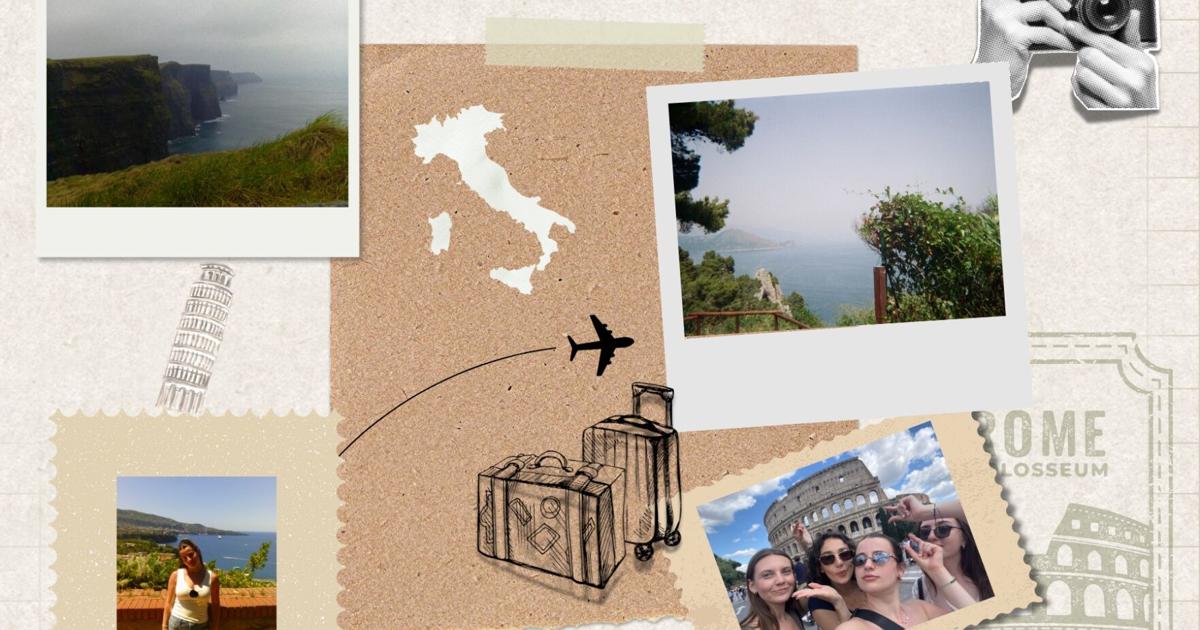
After my first year of university, my mother and I met up with my sister in Italy, who had been studying abroad in England. I couldn’t tell you how easy it was to make this my personality. It felt like such a privilege to post a new location on my Instagram story.
But, I also felt a lot of guilt being there. I didn’t know the language, I didn’t do any research on the artifacts I was seeing and I didn’t pay for a single thing.
When I got back, I wanted to see more of the world — I’d caught the travel bug, as one might call it — but I found that I lacked a purpose to attach to this desire. I started learning Italian, took my first flight by myself to Halifax, N.S. and booked a reading week trip to Ireland.
With both of these following trips, I felt like I was dating the idea of travelling, finding out what I liked about it and what I wanted to avoid.
I like cheap hotels (I have no fear of germs), I like knowing someone in the city I’m staying in, I like talking to locals, I like pretending I’m a local sometimes and acting like a flat-out tourist other times. I also like learning about their culture, their past, their language and supporting their economy by doing lots and lots of shopping.
What I don’t like? Being the navigator, overpacking, packing the wrong things, adapters and converting my money.
Considering the second list is quite a bit smaller, when the opportunity to study abroad was presented to me, I decided to take it. I also had a few scholarships waiting for me to use, and knowing I will never get free money to travel ever again, I joined the Rondine Cittadella della Pace initiative.
The study abroad program was offered through Western International and would only take place during the month of May. I thought it would be a great balance between the six-month exchange program and a single reading week of travelling. It also enticed me that I would be renting an apartment for an entire month, getting totally familiar with one place rather than moving between cities every three days — a typical experience when planning your own vacation.
I was most excited that I would be taking a course to learn Italian. Since my nonna immigrated from Italy, I do have someone to practice with, but this would still give my travel purpose, something I needed.
When I told friends and family what I was doing, everyone was excited for me, but I was nervous about setting high expectations and ruining the trip. I thought very little about moving to Italy.
After arriving, I quickly learned that travelling with more than one person is not easy. It was challenging to coordinate a plan that would please everyone — my friends, my roommates — and I found that no one was talking about it.
The way social media sees study abroad programs is as an international bounty of freedom: smiles on film and clinking flutes of wine. I’m providing a most accurate metaphor here — I was drinking mine, boxed.
Still, I am grateful. I learned from people I will never meet again, and I saw beautiful things.
On a class trip to Rome as part of our lecture, we got the opportunity to hear from a refugee from Belarus. I was able to get their contact information and speak with them again virtually when I got back to London, Ont..
Hearing about their experience escaping war put my petty complaints into perspective. This person was also a journalist, but one unable to practice their work and forced into hiding under a dictatorship. Their story felt incomparable to mine. Still, I was able to learn something from it.
I discovered that one point of travelling can be to see how a country treats the people who were not born there. The journalist said they were welcomed and assisted with open arms in Italy. It was not an easy integration, but it had been worth it — they viewed starting from scratch as a blessing, to live in peace and practice what they are studying.
I learned that no matter the distance, humanity can be shared across language barriers and immensely different narratives.
Continuing my journey, I also learned the beginnings of Italian, which I was never interested in until I felt the inferiority of wandering a city in which I couldn’t understand citizens gossiping on the trains.
One of my favourite nuances, different from the English language, is that Italians, like many Latin-based languages, don’t define themselves by what they feel.
In English, we say ‘I am hungry,’ ‘I am sad’ or even ‘I am 21 years old.’ I find it’s a very American thing to make our feelings a possession, something only alike to us.
In Italian, you say ‘Io ho fame,’ ‘Io ho triste’ and ‘Io ho 21 anni.’ Instead, ‘Io ho’ directly translates to ‘I have.’ I think it’s a beautiful thing to claim that your emotions, even one as dark as sadness, is not something inherent to your being. It is only something you have, momentary, before you can let it go.
You have hunger before you eat.
And you have 21 years before you live the rest of your life, gaining more years, more experiences, seeing more things and feeling more love.
La vita è molta bella when you only look.
link